How *Not* To Do A Grid Reliability Study
How *Not* To Do A Grid Reliability Study
The Union of Concerned Scientists strikes out again
All lies and jest. Still, a man hears what he wants to hear. And disregards the rest”- Paul Simon, reading a Union on Concerned Scientist Report
Have you ever wondered how not to do a grid reliability study? Well, dear reader, today is your lucky day!
In early February, the Union of Concerned Scientists (UCS) released a study titled New England’s Offshore Wind Solution, that claims “wind energy off the New England coast can powerfully reinforce the reliability of the region’s electric grid, particularly during winter when the system is most vulnerable to energy shortages.”.
Specifically, UCS notes:
A Union of Concerned Scientists analysis of winter 2024–2025 wind speed data shows that the energy delivered by just two offshore wind projects, totaling 1,500 megawatts (MW) of capacity, would have lowered the risk of power outages, based on a key reliability metric, by 55 percent over the course of the season [emphasis added]. A larger fleet of 3,500 MW would have reduced the risk of outages by 75 percent. In either case, the scale of energy delivered by an offshore wind fleet would have increased the total winter energy supply from local renewable resources above the energy supply from imported liquefied natural gas.
These are bold claims about offshore wind bolstering grid reliability, especially because they rely on a single metric—energy generation— that doesn’t even account for offshore wind’s (in)ability to meet peak power demand using hourly load profiles.
This is exactly how not to do a grid reliability study!
A closer look at the UCS study reveals serious methodological shortcomings. In the end, UCS makes assertions about improving grid reliability with intermittent resources on the New England grid without addressing the intermittency of those resources themselves.
Despite these flaws, which are glaringly obvious to anyone with a working knowledge of the power sector, media outlets reported on the study largely without scrutiny. One in particular—E&E News by Politico—took a shortened and paraphrased version of what Isaac said via email and placed it in the final two paragraphs of its article. Unfortunately, this is just one example of why so many remain misinformed about intermittent energy resources.
This is where the EBB community comes in, including you. Please like and restack this piece so we can make sure UCS feels as humiliated as possible educate as many people as possible!
The Metric UCS Relies On for Its Claims
When the UCS study says that offshore wind reduces the risk of power outages for ISO-NE “based on a key reliability metric,” the metric it uses is known as the daily energy demand.
Daily energy demand is a metric tracked by ISO-NE. It helps mitigate the risk of winter energy shortfalls when fuel supplies are constrained due to limited natural gas pipeline capacity. Specifically, ISO-NE produces 21-Day Energy Assessments to quantify this risk, describing their purpose as follows:
The purpose of this sophisticated assessment is to identify potential energy shortfalls while there is time to prevent them or lessen their impact. With up to three weeks’ notice, the report gives resource owners time to evaluate the status of their fuel supplies and to arrange for replenishment, as needed, or to reschedule maintenance in order to maximize availability.
Within these reports, ISO-NE highlights the peak forecasted daily energy demand on a scale from Lower Risk to Higher Risk.
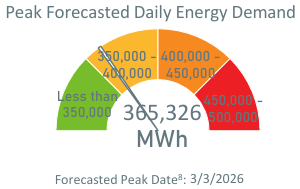
Green represents low risk of energy shortfalls, yellow is elevated risk, orange is higher risk, and red is the highest risk.
This is the metric UCS relies on to claim that offshore wind “can powerfully reinforce the reliability of the region’s electric grid.” Ironically, UCS’s own analysis undermines this conclusion by indirectly revealing how unreliable intermittent generators actually are.
The UCS’s Own Study Refutes Its Main Takeaway
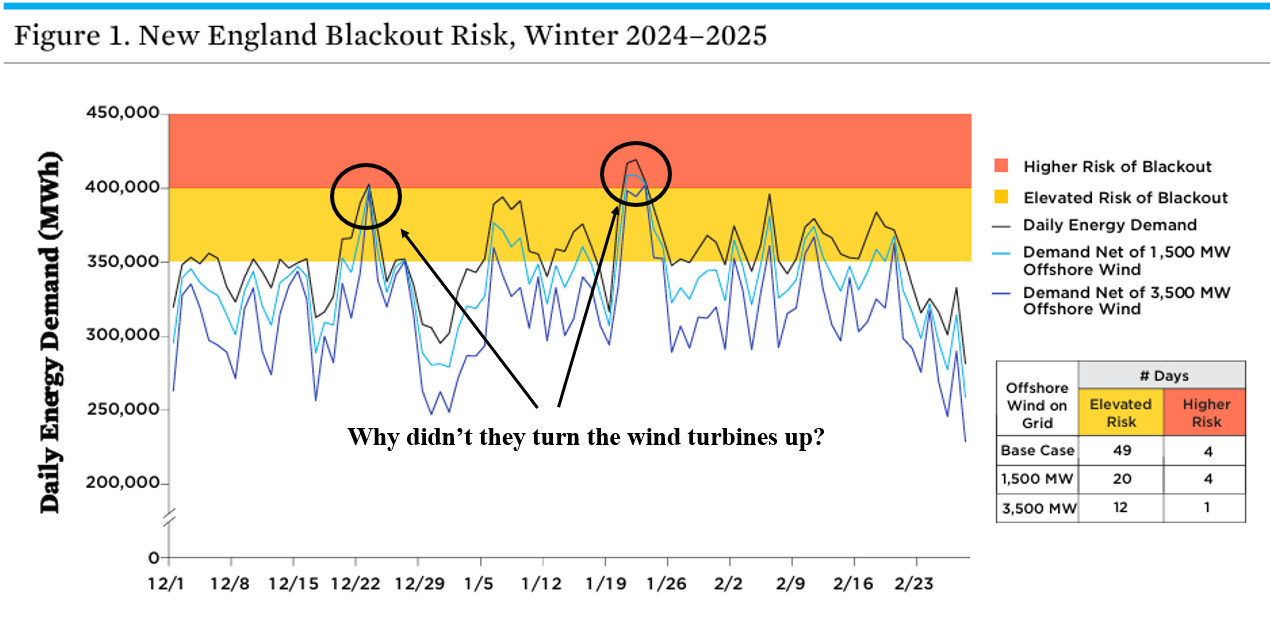
The UCS analysis examines a cold-weather period on the ISO-NE grid from December 1, 2024, through February 28, 2025. During this period, daily energy demand exceeded the elevated-risk threshold of 350,000 megawatt-hours (MWh) on 53 of the 90 days (59 percent). On four of those days, demand exceeded 400,000 MWh—levels ISO-NE classifies as higher risk for energy shortfalls.
As UCS explains, this high daily energy demand “increased the region’s risk of an energy shortfall, a condition that can lead to a blackout.”
UCS’s central claim is that if ISO-NE had 1,500 MW of offshore wind, the added energy would have reduced net daily demand below 350,000 MWh on 29 of the 53 high-risk days—a 55 percent reduction. With 3,500 MW of offshore wind, UCS claims a 75 percent reduction.
UCS presents this data in the chart below, showing actual ISO-NE demand (black line), net demand after including 1,500 MW of offshore wind (blue line), and net demand after including 3,500 MW of offshore wind (purple line).
But a closer look tells a different story.
Figure 1 in the study (shown above) indicates that offshore wind would not have generated very much energy during the peak periods observed around December 22 and from January 19-26th. This data indicates that offshore wind generation dies down when it is needed most, during peak demand periods.
With 1,500 MW of offshore wind, the highest-risk days—those exceeding 400,000 MWh—remain firmly in higher-risk territory. And even 3,500 MW of offshore wind does almost nothing to reduce demand on the most extreme days; all four remain near the 400,000 MWh threshold.
This exposes the central flaw in UCS’s conclusion: the intermittency of offshore wind—entirely ignored by the study—still leaves ISO-NE vulnerable to blackouts on the days that matter most, even using UCS’s own chosen metric.
UCS applies no weighting to the highest-risk days and, as a result, incorrectly claims that offshore wind reduces blackout risk by 55–75 percent. That is not a fair assessment of offshore wind’s contribution to grid reliability.
Worse still, the analysis relies entirely on daily averages. When hourly load shapes and generation profiles are examined, offshore wind performs even more poorly.
How to Actually Do A Grid Reliability Report
Daily energy demand is only an energy metric—it says nothing about reliable capacity. On its own, it is insufficient to support the claims UCS makes about offshore wind improving grid reliability.
A proper grid reliability study evaluates whether the system can meet peak demand. That is precisely where UCS’s conclusions fall apart, because peak-demand analysis exposes the intermittency of offshore wind and the risk of relying too heavily on weather-dependent resources—conditions that directly lead to blackouts.
By sidestepping this reality, the UCS report misleads readers about the reliability value of offshore wind, particularly in light of its concluding statement:
With continued support from New England leaders, the development of an offshore wind fleet promises to bring these reliability and affordability benefits home to consumers in the coming years.
Setting aside the “affordability” claim for now, we wanted to briefly mention that it relies on wholesale power prices while ignoring the fact that costs for offshore wind are borne by ratepayers through long-term power purchase agreements (PPAs), and that even downward pressure on wholesale prices would not prevent higher retail electricity rates.
A meaningful reliability analysis would have focused on offshore wind’s ability to contribute during peak hours.
Our ISO-NE Report, For Example
In our ISO-NE report, we modeled the resource mix required to meet New England’s decarbonization mandates, with a focus on both cost and reliability.
Using hourly load shapes and historical weather years, our analysis shows just how little offshore wind and other intermittent resources contribute to reliability.
We first evaluated the 2024 ISO-NE Economic Planning for the Clean Energy Transition (EPCET) resource mix, which included more than 97 GW of new renewable capacity: 34,400 MW of offshore wind, 27,500 MW of solar, 7,500 MW of onshore wind, and 27,600 MW of battery storage.
Even with this massive buildout, the system failed to meet ISO-NE’s projected 2050 demand growth. Stress-testing the system with 2023 historical weather data revealed an 18-hour blackout in December caused by a prolonged wind drought.
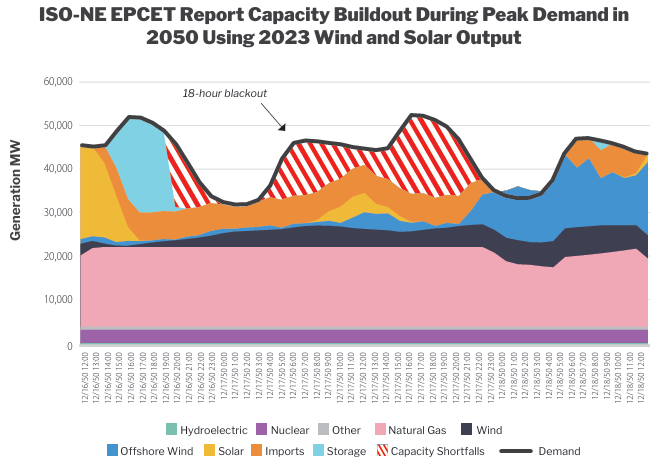
As you can see, wind and solar resource output were minimal, imports were maxed out, and battery storage was fully depleted. A blackout of this magnitude in the middle of winter would be devastating for the region.
After finding the EPCET resource mix inadequate, we modeled a system that could ensure reliability using the same 2023 data. That system required 66,000 MW of offshore wind, 68,300 MW of solar, 19,100 MW of onshore wind, and 42,900 MW of battery storage—more than double the total capacity in the EPCET study.
This modeled resource mix also included roughly 20,500 MW of natural gas capacity, 3,350 MW of nuclear, and 3,780 MW of hydro and pumped storage.
While this was sufficient to fill the reliability gaps for the 2023 historical test year, it wasn’t for other test years.
With nearly 19 times the offshore wind capacity UCS claims would reduce outage risk by 75 percent, ISO-NE would still experience blackouts during extended wind droughts. One example shows a six-hour capacity shortfall in December when tested against 2019 weather data.
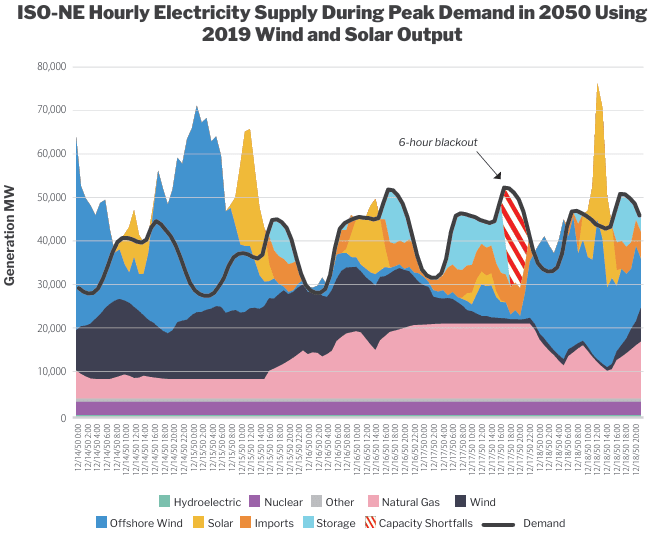
Keep in mind that the data used for demand, generation, and weather inputs in our analysis were provided by ISO-NE.
This is what a real grid reliability study looks like—and the conclusion is unavoidable: offshore wind contributes very little to reliability, and more reliable and affordable solutions exist that can reduce the risk of blackouts on the ISO-NE grid.
Conclusion and the Real Solution to New England’s Risk of Blackouts
ISO-NE focuses on daily energy demand for a simple reason: New England is dangerously reliant on just-in-time natural gas deliveries that compete with home heating and are constrained by insufficient pipeline capacity.
This is an issue Meredith Angwin has been sounding the alarm on for years.
The solution is not to overbuild the grid with intermittent resources like offshore wind, which are also energy-limited on days the wind doesn’t blow and the sun doesn’t shine. The solution is to build larger oil tanks, expand pipeline capacity, and invest in reliable, dispatchable resources with on-site fuel storage.
At least with thermal, fuel-based resources, constraints can be addressed by storing more fuel or building more pipeline capacity. With weather-dependent resources, the only option is massive overbuilding the grid to accommodate the issue of intermittency—and even that may not be enough.
Unfortunately for New England consumers, current decarbonization policies prevent these common-sense solutions from being implemented.
Despite the mounting evidence of reliability concerns when over-reliant on weather-based resources, reports like the UCS study—and the uncritical coverage they receive—continue to misinform the public about the real drivers of grid reliability.
Views: 19
Comment
-
Comment by Thinklike A. Mountain on March 4, 2026 at 1:46pm
-
GOP Hates MAGA and Trump – The Only President in History to Have Recess Appointments Blocked by His Own Party
https://joehoft.com/gop-hates-maga-trump-only-president-history-have/
Maine as Third World Country:
CMP Transmission Rate Skyrockets 19.6% Due to Wind Power
Click here to read how the Maine ratepayer has been sold down the river by the Angus King cabal.
Maine Center For Public Interest Reporting – Three Part Series: A CRITICAL LOOK AT MAINE’S WIND ACT
******** IF LINKS BELOW DON'T WORK, GOOGLE THEM*********
(excerpts) From Part 1 – On Maine’s Wind Law “Once the committee passed the wind energy bill on to the full House and Senate, lawmakers there didn’t even debate it. They passed it unanimously and with no discussion. House Majority Leader Hannah Pingree, a Democrat from North Haven, says legislators probably didn’t know how many turbines would be constructed in Maine if the law’s goals were met." . – Maine Center for Public Interest Reporting, August 2010 https://www.pinetreewatchdog.org/wind-power-bandwagon-hits-bumps-in-the-road-3/From Part 2 – On Wind and Oil Yet using wind energy doesn’t lower dependence on imported foreign oil. That’s because the majority of imported oil in Maine is used for heating and transportation. And switching our dependence from foreign oil to Maine-produced electricity isn’t likely to happen very soon, says Bartlett. “Right now, people can’t switch to electric cars and heating – if they did, we’d be in trouble.” So was one of the fundamental premises of the task force false, or at least misleading?" https://www.pinetreewatchdog.org/wind-swept-task-force-set-the-rules/From Part 3 – On Wind-Required New Transmission Lines Finally, the building of enormous, high-voltage transmission lines that the regional electricity system operator says are required to move substantial amounts of wind power to markets south of Maine was never even discussed by the task force – an omission that Mills said will come to haunt the state.“If you try to put 2,500 or 3,000 megawatts in northern or eastern Maine – oh, my god, try to build the transmission!” said Mills. “It’s not just the towers, it’s the lines – that’s when I begin to think that the goal is a little farfetched.” https://www.pinetreewatchdog.org/flaws-in-bill-like-skating-with-dull-skates/
Not yet a member?
Sign up today and lend your voice and presence to the steadily rising tide that will soon sweep the scourge of useless and wretched turbines from our beloved Maine countryside. For many of us, our little pieces of paradise have been hard won. Did the carpetbaggers think they could simply steal them from us?
We have the facts on our side. We have the truth on our side. All we need now is YOU.
“First they ignore you, then they laugh at you, then they fight you, then you win.”
-- Mahatma Gandhi
"It's not whether you get knocked down: it's whether you get up."
Vince Lombardi
Task Force membership is free. Please sign up today!
Hannah Pingree on the Maine expedited wind law
Hannah Pingree - Director of Maine's Office of Innovation and the Future
"Once the committee passed the wind energy bill on to the full House and Senate, lawmakers there didn’t even debate it. They passed it unanimously and with no discussion. House Majority Leader Hannah Pingree, a Democrat from North Haven, says legislators probably didn’t know how many turbines would be constructed in Maine."
https://pinetreewatch.org/wind-power-bandwagon-hits-bumps-in-the-road-3/
© 2026 Created by Webmaster.
Powered by


You need to be a member of Citizens' Task Force on Wind Power - Maine to add comments!
Join Citizens' Task Force on Wind Power - Maine