Pick your Poison, but Wind, Solar and Batteries are Most Toxic
ISO-New England: Electrocute Everything
Go Pats and three alternatives to the chair
In 1903, as part of his campaign against alternating current, Thomas Edison helped stage the public electrocution of Topsy the elephant at Coney Island.
Topsy was killed after her owners and handlers at Luna Park concluded she was too dangerous and too expensive to keep following a series of incidents, most notably the fatal injury of a handler in 1902. Rather than relocate her or carry out a quiet euthanasia, park management chose to turn her death into a public demonstration.
Today, five of the six New England states are pursuing a policy agenda that can fairly be summarized the same way: electrocute everything—mandating rapid decarbonization of the electricity sector while simultaneously requiring the electrification of home heating and transportation.
Luckily, there are alternatives to this Pachyderm-like pain, and they are all laid out in a handy-dandy report published by a coalition of New England public policy groups1 entitled “Alternatives to New England’s Energy Affordability Crisis,” written by the team at Always On Energy Research.
Crunching the Numbers
Our report calculated the cost and reliability implications of “electrifying everything” in New England under four scenarios.
The Renewable scenario: Detailed in this article, this scenario attempts to meet rising demand using onshore wind, offshore wind, solar, battery storage, and existing nuclear and natural gas facilities.
Nuclear scenario: This scenario uses existing gas and builds new natural gas and nuclear plants to meet demand, with nuclear accounting for 90 percent of the electricity mix by 2050.
Natural Gas scenario: This scenario adds new natural gas plants and pipelines to meet rising demand, with gas accounting for 83 percent of generation in 2050 and existing nuclear accounting for 12 percent.
Happy Medium: This scenario adds nuclear and natural gas capacity, resulting in 47 percent nuclear, 47 percent natural gas, and 3 percent hydro and “other” in 2050.
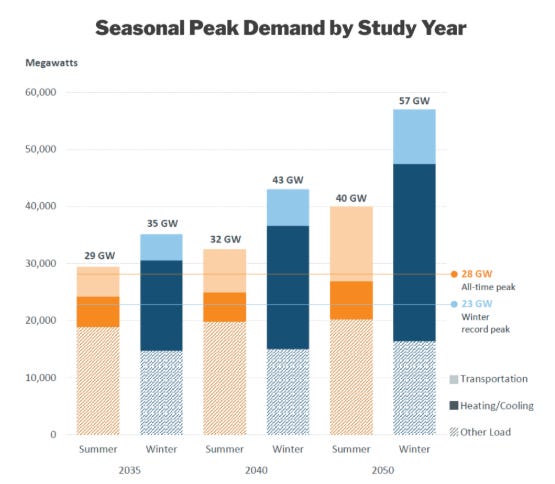
According to ISO-New England, electrifying home heating and transportation will increase the peak demand to around 57 gigawatts (GW), up from the all-time peak of 28 GW. Unlike the current peak, the forecast peak in 2050 will be in winter, not summer, due to the massive need for electricity for home heating.
Our analysis praises the wisdom of New Hampshire because it is not pursuing an electrification agenda, so we downwardly revised our system peak demand to 52.5 GW to reflect the common-sense approach to energy policy taken in the Granite State.
Meeting this 52.5 GW of future winter demand will require a massive increase in installed capacity for all scenarios. The Renewable scenario would require the most capacity, needing 225 GW to meet demand due to the intermittency of the wind and solar resources, while each of the other three scenarios could meet the projected peak with a little more than 60 GW, maintaining a healthy reserve margin.
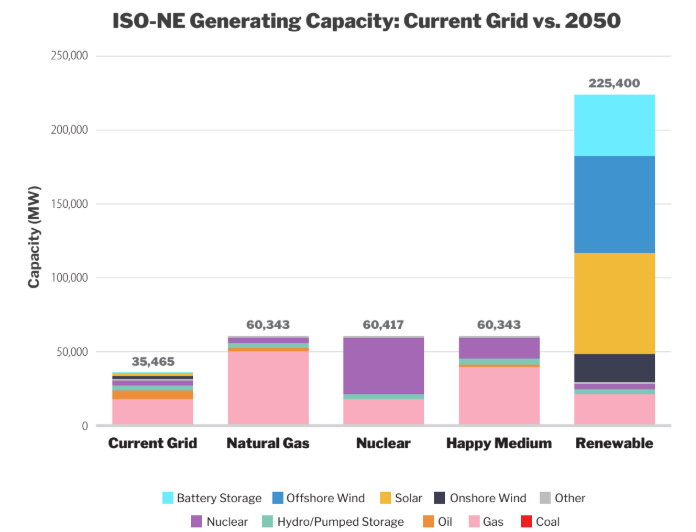
This means the Renewable scenario required 3.75 times more capacity than the scenarios that used nuclear and natural gas to meet growing demand.
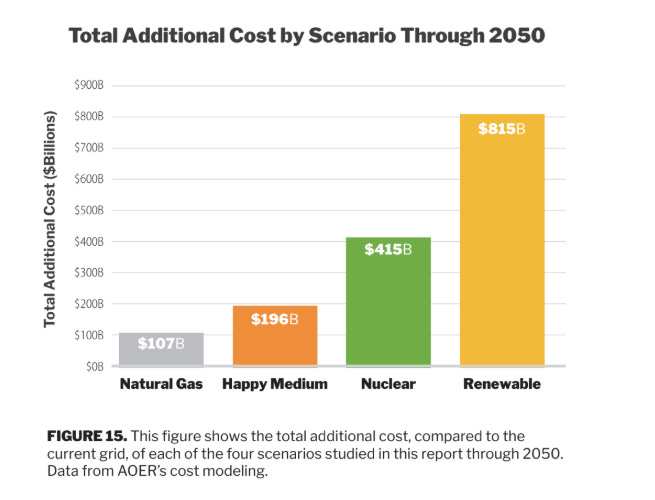
Building out this additional capacity for the region’s electrification efforts will be expensive, and the cost of electricity will rise for consumers in every scenario. However, the Renewable scenario takes the cake at an additional $815 billion, compared to $415 billion for the Nuclear scenario, $196 billion in the Happy Medium scenario, and just $107 billion in the Natural Gas scenario, as you can see in the graph below.
These costs will get passed on to ratepayers.
The Nuclear scenario would increase prices by 64.8 percent, the Natural Gas scenario by 13 percent, and the Happy Medium scenario by 26.5 percent. In comparison, prices in the Renewable scenario would increase by 126.4 percent, with massive impacts for New England families.
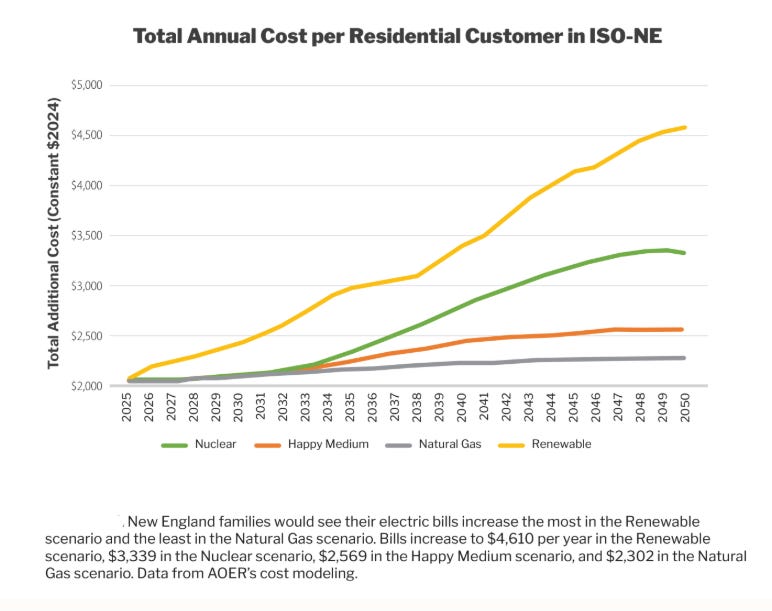
In 2024, residential customers paid an average yearly cost of $2,100 for their electricity. Under the Renewable scenario, residential electricity prices would more than double by 2050, increasing New England families’ annual electricity costs to $4,610. Bills would rise to $3,339 annually in the Nuclear scenario, $2,302 in the Natural Gas scenario, and $2,569 in the Happy Medium scenario by 2050.
Despite the massive cost of the Renewable scenario, it is the least reliable of the four scenarios studied.
Outgoing ISO-New England CEO Agrees, Renewables Won’t Keep the Lights On
On December 31st, Gordon van Welie —who we are reliably told is a silver fox—stepped down as the President and CEO of ISO-New England. Prior to exiting the stage, he did not mince words about the reliability challenges being posed by public policies in New England.
"We cannot operate the system in the wintertime without a dependable energy source that can balance the system when the sun doesn't shine, and the wind doesn't blow. I think policymakers sometimes lose sight of that fact.”
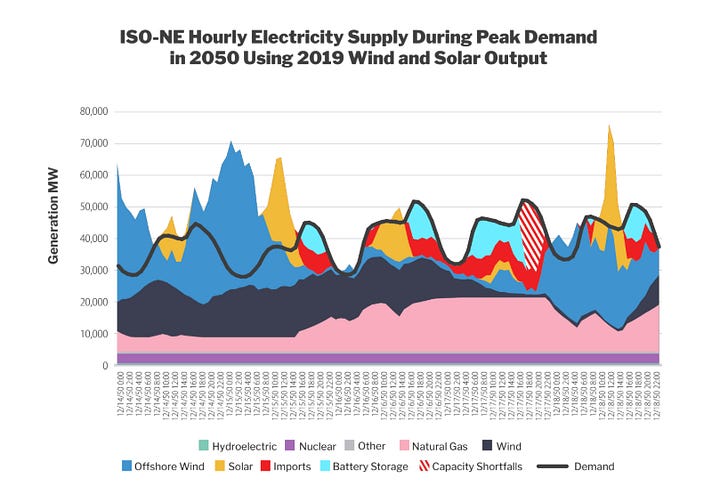
Mr. van Welie’s statements match very well with the results of our analysis. We found that of the four scenarios we studied—the Renewable, Nuclear, Happy Medium, and Natural Gas scenarios—only the Renewable scenario would have rolling blackouts, while the other scenarios easily meet the rising demand for electricity to power electrified home heating.
After stress-testing the ISO-New England across different weather years and wind and solar output, ISO-NE would experience a six-hour blackout in the Renewable scenario if the hourly wind and solar capacity factors matched those observed in 2019
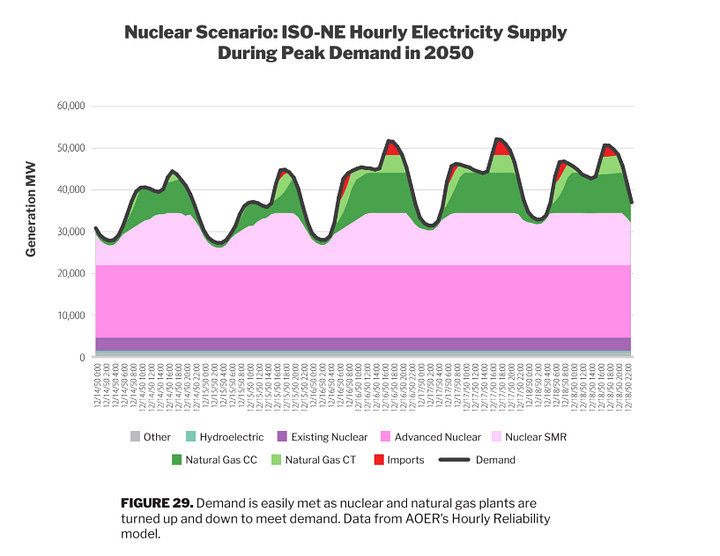
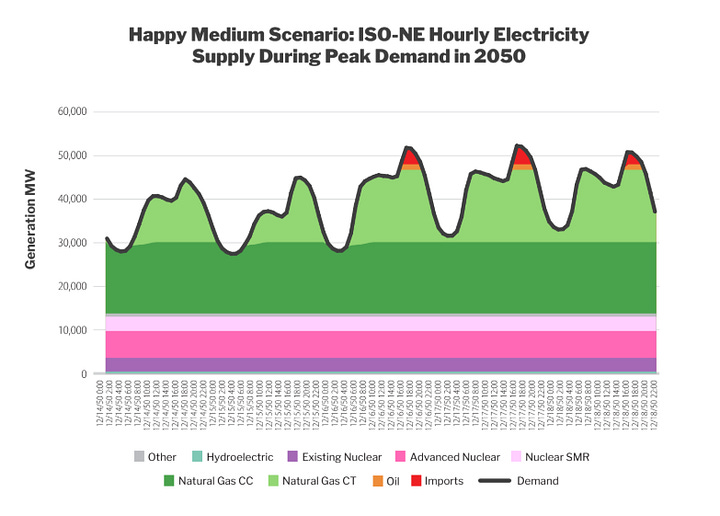
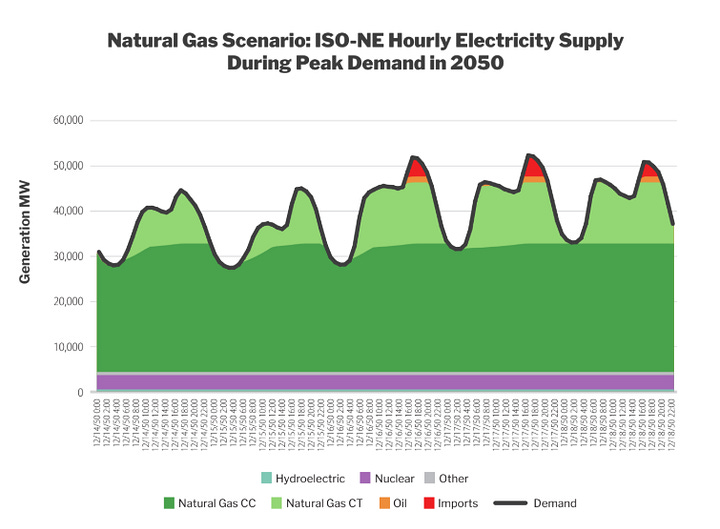
The other scenarios, however, would constitute what Meredith Angwin calls a “boring” electric grid with no reliability drama. But we ask our readers, where’s the fun in that?
Levelized Cost of Resources
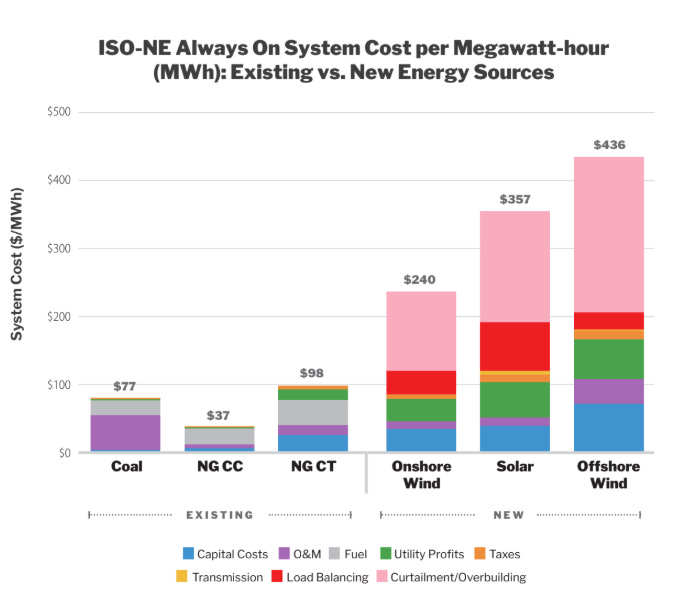
We also conducted our “Always On” Levelized Cost of Energy Analysis to compare the cost of serving load with each energy resource in the scenarios studied.
As we detailed in our previous piece, attempting to meet this heightened demand in the Renewable scenario with offshore wind would cost $436 per megawatt hour (MWh), solar would cost $357 per MWh, and onshore wind would cost $240 per MWh.
Meeting the demand in the Nuclear scenario with small modular reactors and large advanced nuclear reactors would cost $253 per MWh and $185, respectively. It’s important to note that the increased cost of SMRs in the Nuclear scenario is driven by the fact that the units would not be utilized as often, as they are partly used to provide ramping ability to meet peak loads. This is shown in the “ramping” portion of the stacked bar chart.
In comparison, the Natural Gas and Happy Medium scenarios use traditional natural gas peaking resources, thus saving billions of dollars, and there is no need to ramp the SMRs because they can run at full speed.
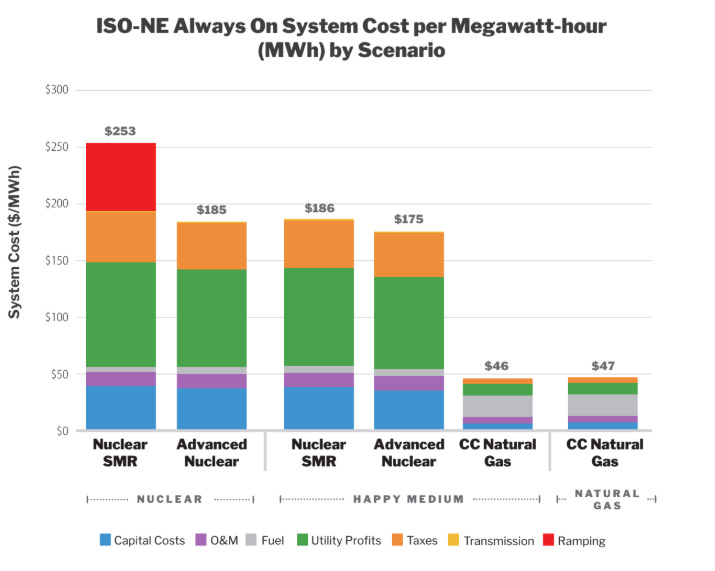
Lastly, the costs of $46 and $47 per MWh in the Happy Medium and Natural Gas scenarios provide the lowest-cost power to the system.
Conclusion
Of course, each of these scenarios is expensive, so any common-sense individual might question the merits of attempting to electrify home heating and transportation at all, given the huge increases in electricity generation capacity that will only be used for five to six months per year.
We’re not optimistic that New Englanders will exhibit that much common sense. But our hope is that this report can restart the conversation about nuclear and natural gas pipelines in the Bay Area for the first time in a very long time.
Views: 40
Comment
Maine as Third World Country:
CMP Transmission Rate Skyrockets 19.6% Due to Wind Power
Click here to read how the Maine ratepayer has been sold down the river by the Angus King cabal.
Maine Center For Public Interest Reporting – Three Part Series: A CRITICAL LOOK AT MAINE’S WIND ACT
******** IF LINKS BELOW DON'T WORK, GOOGLE THEM*********
(excerpts) From Part 1 – On Maine’s Wind Law “Once the committee passed the wind energy bill on to the full House and Senate, lawmakers there didn’t even debate it. They passed it unanimously and with no discussion. House Majority Leader Hannah Pingree, a Democrat from North Haven, says legislators probably didn’t know how many turbines would be constructed in Maine if the law’s goals were met." . – Maine Center for Public Interest Reporting, August 2010 https://www.pinetreewatchdog.org/wind-power-bandwagon-hits-bumps-in-the-road-3/From Part 2 – On Wind and Oil Yet using wind energy doesn’t lower dependence on imported foreign oil. That’s because the majority of imported oil in Maine is used for heating and transportation. And switching our dependence from foreign oil to Maine-produced electricity isn’t likely to happen very soon, says Bartlett. “Right now, people can’t switch to electric cars and heating – if they did, we’d be in trouble.” So was one of the fundamental premises of the task force false, or at least misleading?" https://www.pinetreewatchdog.org/wind-swept-task-force-set-the-rules/From Part 3 – On Wind-Required New Transmission Lines Finally, the building of enormous, high-voltage transmission lines that the regional electricity system operator says are required to move substantial amounts of wind power to markets south of Maine was never even discussed by the task force – an omission that Mills said will come to haunt the state.“If you try to put 2,500 or 3,000 megawatts in northern or eastern Maine – oh, my god, try to build the transmission!” said Mills. “It’s not just the towers, it’s the lines – that’s when I begin to think that the goal is a little farfetched.” https://www.pinetreewatchdog.org/flaws-in-bill-like-skating-with-dull-skates/
Not yet a member?
Sign up today and lend your voice and presence to the steadily rising tide that will soon sweep the scourge of useless and wretched turbines from our beloved Maine countryside. For many of us, our little pieces of paradise have been hard won. Did the carpetbaggers think they could simply steal them from us?
We have the facts on our side. We have the truth on our side. All we need now is YOU.
“First they ignore you, then they laugh at you, then they fight you, then you win.”
-- Mahatma Gandhi
"It's not whether you get knocked down: it's whether you get up."
Vince Lombardi
Task Force membership is free. Please sign up today!
Hannah Pingree on the Maine expedited wind law
Hannah Pingree - Director of Maine's Office of Innovation and the Future
"Once the committee passed the wind energy bill on to the full House and Senate, lawmakers there didn’t even debate it. They passed it unanimously and with no discussion. House Majority Leader Hannah Pingree, a Democrat from North Haven, says legislators probably didn’t know how many turbines would be constructed in Maine."
https://pinetreewatch.org/wind-power-bandwagon-hits-bumps-in-the-road-3/
© 2026 Created by Webmaster.
Powered by


You need to be a member of Citizens' Task Force on Wind Power - Maine to add comments!
Join Citizens' Task Force on Wind Power - Maine