Electric Vehicles ARE Done. Ford has a better idea...Trash the EV Market.
Ford Axes Electric F-150 Lightning, Takes $19.5 Billion Hit as EV Market Crumbles

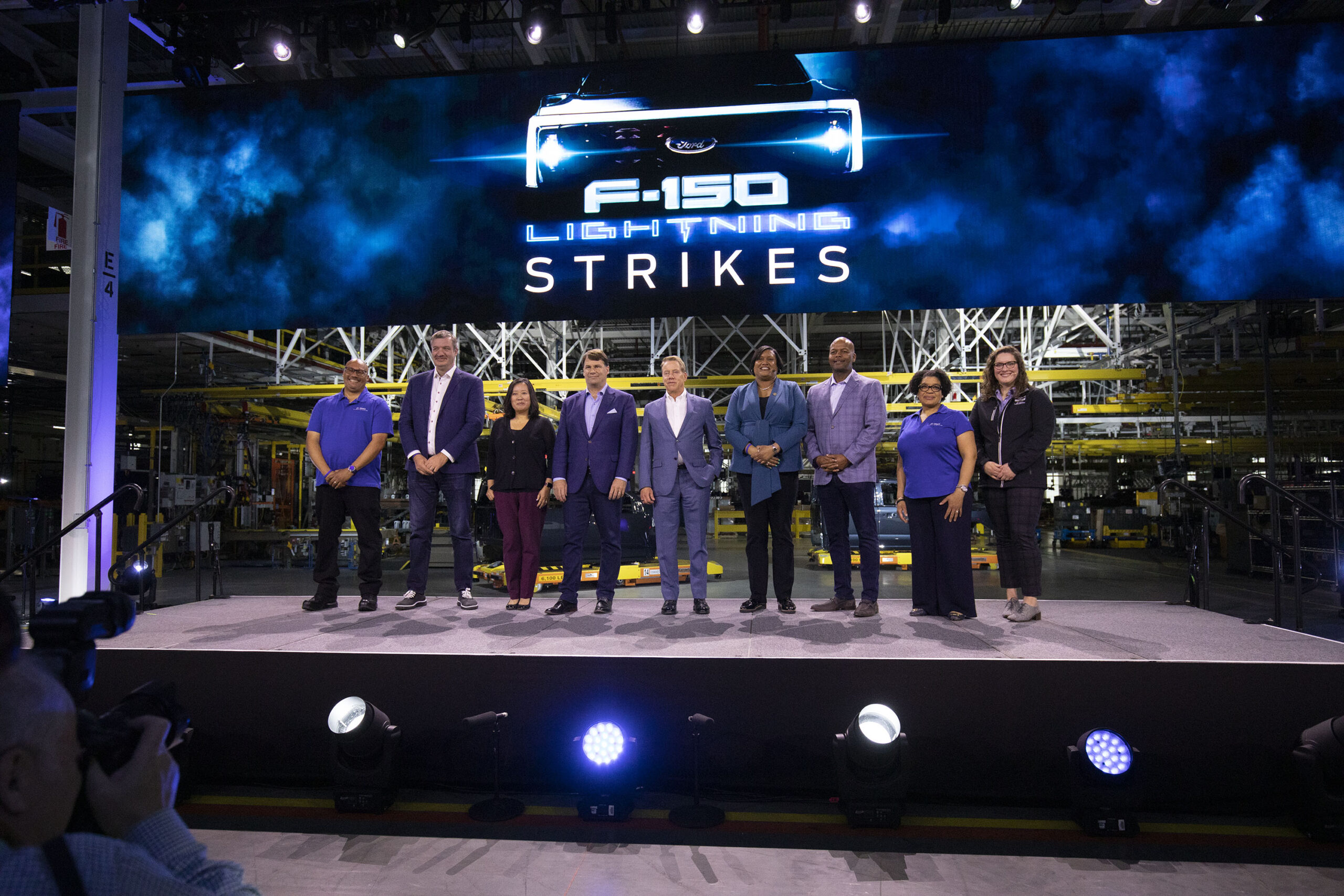
‘We’re following customers to where the market is, not where people thought it was going to be, but where it is today,’ Ford chief executive Jim Farley says.
Ford Executive Chairman Bill Ford (5th L) and chief executive Jim Farley (4th L) pose for a photo on stage at the launch of the electric Ford F-150 Lightning pickup truck in 2022. Bill Pugliano/Getty ImagesFord Motor Co. has announced a dramatic retreat from its all-electric ambitions, saying it will take a massive $19.5 billion writedown and discontinue the fully electric F-150 Lightning.
The move comes as the U.S. auto industry grapples with a sharp collapse in electric vehicle demand following the expiration of federal tax credits.
In a significant pivot for the Detroit automaker, Ford plans to replace the F-150 Lightning with a new extended-range electric model that uses a gas-powered engine to recharge the battery. The company also is scrapping plans for its next-generation electric truck, codenamed T3, as well as its planned electric commercial vans.
The restructuring will require a staggering financial hit. The company expects to record $19.5 billion in special items, with the majority of charges occurring in the fourth quarter. This includes $8.5 billion related to canceling planned EV models, $6 billion tied to the dissolution of a battery joint venture with South Korea’s SK On, and $5 billion in “program-related expenses.”
Ford’s chief executive, Jim Farley, cited shifting market dynamics as the primary driver for the decision.
“When the market really changed over the last couple of months, that was really the impetus for us to make the call,” Mr. Farley told Reuters. Speaking to CNBC, he added, “The last couple of months have been really clear to us. The very high-end EVs — the $50,000, $70,000, $80,000 vehicles — they just weren’t selling.”
Ford’s strategy is now shifting aggressively toward hybrid vehicles. The automaker expects that by 2030, its global mix of hybrids, extended-range EVs, and pure EVs will reach 50 percent, up from just 17 percent today.
“We evaluated the market, and we made the call,” Mr. Farley said on CNBC. “We’re following customers to where the market is, not where people thought it was going to be, but where it is today.”
Despite the massive writedowns, Ford raised its 2025 guidance for adjusted earnings before interest and taxes to about $7 billion. The company hopes these changes will provide a path to profitability for its Model E electric vehicle business by 2029.
Ford’s retreat mirrors a broader crisis in the U.S. electric vehicle market. Demand has nosedived following the September 30 expiration of the $7,500 federal consumer tax credit — a policy change enacted by the Trump administration.
According to data from Cox Automotive, the impact was immediate and severe. Electric vehicle sales fell dramatically in October to 74,835 units, a 48.9 percent decline month-over-month and a 30.3 percent drop compared to the previous year.
“We expected this shift in the electric vehicle market,” said Cox senior analyst Stephanie Valdez Streaty. “With the IRA-backed sales incentives gone, lower-cost EV volume was hit hard, pushing the mix toward more luxury and driving October’s EV ATP to a 2025 high of $59,125 — now $9,359 above the industry average. Affordability has always been the core challenge with EV sales, and this reset only underscores how critical it is to bring more attainable EV options to market.”
With the loss of federal support, lease prices have surged, and automakers are left with diminishing incentives to push battery-powered models. While Ford is pulling back on large electric trucks, it noted it will concentrate future North American EV development on a low-cost “Universal EV Platform” designed for smaller, more affordable vehicles, starting with a midsize pickup in 2027.
Tesla has also felt the pain, but as consumers search for more affordable options, the Elon Musk company appears to be rebounding. After the third quarter, the last with the $7,500 tax credit, Tesla’s market share dropped nearly in half to just 41 percent compared to five years ago. But in October, sales rose 55 percent, followed by another 57 percent jump in November even as absolute sales fell from more than 60,000 in September to less than 40,000 in November. “The subsidy removal essentially stress-tested every brand’s underlying demand, and Tesla’s decline was significantly smaller,” Ms. Streaty told Sherwood News. “Whether that’s due to brand strength, infrastructure advantages like the Supercharger network, or simply less price-sensitive buyers is debatable, but the market share result is mathematical: when everyone declines, whoever declines least gains share.”

Views: 55
Comment
-
Comment by Thinklike A. Mountain on January 7, 2026 at 11:59am
-
Here’s the damning email that confirms the CIA overthrew the US govt. in 2020
“Trying to give the incapacitated vegetable, particularly during the debate on Thursday, a talking point to push back on Trump on this issue.” CIA John Brennan; “Ok Michael, add my name to the list. Good initiative. Thanks for asking me to sign on.” —————— It wasn’t just 51 former intelligence officials who were involved. The Central Intelligence Agency itself was actively involved as well, and its director, Gina Haspel, approved it.
Weblink:
https://revolver.news/2026/01/heres-the-damning-email-that-confirms...
-
-
NGO Leader Lists Million Dollar Falmouth, Maine McMansion for Sale After Homeland Security, House Oversight Probe His Migrant Agency
https://robinsonreport.substack.com/p/celebrated-democrat-ngo-leade...
Maine as Third World Country:
CMP Transmission Rate Skyrockets 19.6% Due to Wind Power
Click here to read how the Maine ratepayer has been sold down the river by the Angus King cabal.
Maine Center For Public Interest Reporting – Three Part Series: A CRITICAL LOOK AT MAINE’S WIND ACT
******** IF LINKS BELOW DON'T WORK, GOOGLE THEM*********
(excerpts) From Part 1 – On Maine’s Wind Law “Once the committee passed the wind energy bill on to the full House and Senate, lawmakers there didn’t even debate it. They passed it unanimously and with no discussion. House Majority Leader Hannah Pingree, a Democrat from North Haven, says legislators probably didn’t know how many turbines would be constructed in Maine if the law’s goals were met." . – Maine Center for Public Interest Reporting, August 2010 https://www.pinetreewatchdog.org/wind-power-bandwagon-hits-bumps-in-the-road-3/From Part 2 – On Wind and Oil Yet using wind energy doesn’t lower dependence on imported foreign oil. That’s because the majority of imported oil in Maine is used for heating and transportation. And switching our dependence from foreign oil to Maine-produced electricity isn’t likely to happen very soon, says Bartlett. “Right now, people can’t switch to electric cars and heating – if they did, we’d be in trouble.” So was one of the fundamental premises of the task force false, or at least misleading?" https://www.pinetreewatchdog.org/wind-swept-task-force-set-the-rules/From Part 3 – On Wind-Required New Transmission Lines Finally, the building of enormous, high-voltage transmission lines that the regional electricity system operator says are required to move substantial amounts of wind power to markets south of Maine was never even discussed by the task force – an omission that Mills said will come to haunt the state.“If you try to put 2,500 or 3,000 megawatts in northern or eastern Maine – oh, my god, try to build the transmission!” said Mills. “It’s not just the towers, it’s the lines – that’s when I begin to think that the goal is a little farfetched.” https://www.pinetreewatchdog.org/flaws-in-bill-like-skating-with-dull-skates/
Not yet a member?
Sign up today and lend your voice and presence to the steadily rising tide that will soon sweep the scourge of useless and wretched turbines from our beloved Maine countryside. For many of us, our little pieces of paradise have been hard won. Did the carpetbaggers think they could simply steal them from us?
We have the facts on our side. We have the truth on our side. All we need now is YOU.
“First they ignore you, then they laugh at you, then they fight you, then you win.”
-- Mahatma Gandhi
"It's not whether you get knocked down: it's whether you get up."
Vince Lombardi
Task Force membership is free. Please sign up today!
Hannah Pingree on the Maine expedited wind law
Hannah Pingree - Director of Maine's Office of Innovation and the Future
"Once the committee passed the wind energy bill on to the full House and Senate, lawmakers there didn’t even debate it. They passed it unanimously and with no discussion. House Majority Leader Hannah Pingree, a Democrat from North Haven, says legislators probably didn’t know how many turbines would be constructed in Maine."
https://pinetreewatch.org/wind-power-bandwagon-hits-bumps-in-the-road-3/
© 2026 Created by Webmaster.
Powered by


You need to be a member of Citizens' Task Force on Wind Power - Maine to add comments!
Join Citizens' Task Force on Wind Power - Maine